RESEARCH

Vijil Labs

You should not have to trust us

Vijil invests in fundamental research to drive innovations that differentiate us in a growing market. Our inventions and publications answer one durable question: how can we trust a multi-agent system to act in the interest of its principal? First, we study the collective behavior of agents, where novel failure modes such as collusion emerge. Second, we intervene throughout the agent lifecycle: from specification to verification through formal methods and adversarial agents. Third, we build metrics that quantify alignment to a specific principal rather than to aggregated preferences. Fourth, we design evolutionary mechanisms to harden the construction and runtime of agents for better reliability, security, and safety.

PUBLICATIONS & ARTIFACTS

Published work

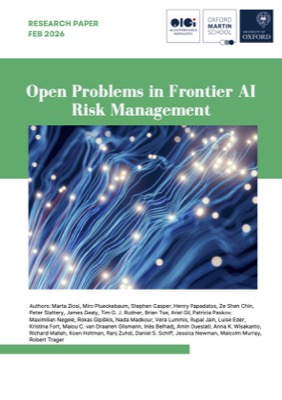
Cover of Open Problems in Frontier AI Risk Management, an Oxford Martin AI Governance Initiative research paperFEATURED PAPEROpen Problems in Frontier AI Risk ManagementWhere the frontier risk-management process is still unresolved, and who is best placed to solve each gap.Ziosi, Plueckebaum, Casper, … Rudner (Vijil), … Trager · Oxford Martin AI Governance Initiative · Feb 2026Read the report →
PAPERS
What the platform runs on

Each of these underwrites a mechanism you can go and check on a product page.

Improving Semantic Uncertainty Quantification in Language Model Question-Answering via Token-Level Temperature Scaling
nonfactuality detection
Lamb, Ivanova, Torr, Rudner (Vijil) · Preprint · arXiv:2604.07172 · 2026
Embedding Trust: Semantic Isotropy Predicts Nonfactuality in Long-Form Text Generation
nonfactuality detection
Bhardwaj, Kempe, Rudner (Vijil) · ICML 2026 · arXiv:2510.21891 · 2025
Red Teaming AI Red Teaming
the adversarial method
Majumdar (Vijil), Pendleton, Gupta · CAMLIS 2025 · arXiv:2507.05538 · 2025
Consistency in Language Models: Current Landscape, Challenges, and Future Directions
the reliability dimension
Novikova, Anderson, Blili-Hamelin, Majumdar (Vijil) · ICML 2025 workshop (R2-FM) · arXiv:2505.00268 · 2025
Improving Consistency in Large Language Models through Chain of Guidance
the reliability dimension
Raj, Gupta, Rosati, Majumdar (Vijil) · TMLR 2025 · arXiv:2502.15924 · 2025
Embedding-Based Classifiers Can Detect Prompt Injection Attacks
Dome’s runtime detectors
Ayub, Majumdar · CAMLIS 2024 · arXiv:2410.22284 · 2024
Is ETHICS About Ethics? Evaluating the ETHICS Benchmark
why a score is not evidence
Hancox-Li (Vijil), Blili-Hamelin · Preprint · arXiv:2410.13009 · 2024
Evaluating Defences Against Unsafe Feedback in RLHF
the safety dimension
Rosati, Edkins, Raj, Atanasov, Majumdar (Vijil), et al. · AAAI 2025 workshop (AICS) · arXiv:2409.12914 · 2024
garak: A Framework for Security Probing Large Language Models
Diamond’s probe framework
Derczynski, Galinkin, Martin, Majumdar (Vijil), Inie · Preprint · arXiv:2406.11036 · 2024
Representation Noising: A Defence Mechanism Against Harmful Finetuning
the safety dimension
Rosati, Wehner, Williams, et al., incl. Majumdar (Vijil) · NeurIPS 2024 · arXiv:2405.14577
Other work by our people

Published by Vijil researchers, and not part of the platform.

VQ-Transplant: Efficient VQ-Module Integration for Pre-trained Visual Tokenizers
Fang, Yuan, Kong, Rudner (Vijil) · ICLR 2026 · arXiv:2607.19575 · 2026
Open Problems in Frontier AI Risk Management
Ziosi, Plueckebaum, Casper, et al., incl. Rudner (Vijil) · Oxford Martin AI Governance Initiative · 2026
Localized LoRA: A Structured Low-Rank Approximation for Efficient Fine-Tuning
Barazandeh, Majumdar (Vijil), Rajyaguru, Michailidis · ICMLA 2025 · arXiv:2506.00236 · 2025
Stop Treating ‘AGI’ as the North-Star Goal of AI Research
Blili-Hamelin, Graziul, Hancox-Li (Vijil), et al. · ICML 2025 · arXiv:2502.03689
Unsocial Intelligence: An Investigation of the Assumptions of AGI Discourse
Blili-Hamelin, Hancox-Li (Vijil), Smart · AIES 2024 · arXiv:2401.13142 · 2024
Showing all 15 papers · sorted by recency
More research notes on the Vijil blog.
MODELS

Detectors we train and serve

Each is a ModernBERT classifier small enough to run on CPU. Self-hosted through Vijil Dome, they run in your own process and your data stays with you. Vijil also serves all three through one detection API.

Prompt injection
Flags prompt-injection attempts in what an agent reads. On a held-out set of 75,011 samples it reaches 97.8% balanced accuracy, with a 2.3% false-positive rate and a 2.2% false-negative rate.
EEOC stereotypes
Flags stereotypes, harmful generalizations and differential treatment aimed at EEOC-protected classes. On an in-distribution test set of 4,253 examples it scores an AUC of 0.923; at the default threshold it catches 86.6% of stereotypes with a 14.5% false-positive rate. On the HateCheck benchmark it catches 86.3%, with a 20.8% false-positive rate on non-hateful text.
Content moderation
Flags toxic and harmful content in an agent’s inputs and outputs. Self-hosted, it needs no third-party moderation API and has no per-call cost.

Figures are from each model’s evaluation card: prompt-injection-v5-20260827 and stereotype-detector-v8-20260911, the latest versions. Accuracy and rates are measured at the default threshold of 0.5. Vijil Dome’s packaged EEOC detector still loads an earlier version, and the moderation model has no published evaluation yet. Detection methods in the docs

Use the detector API

Try to beat our detector

Benchmark our prompt-injection detector against yours. It is on Hugging Face, it is small enough to run on your own hardware, and we would rather hear where it loses than where it wins — which is the only kind of marketing this page’s readers should accept.